The discovery in 2018 of superconductivity in low-angle twisted bilayers of graphene have triggered intense interest on this system. Later studies have shown that this system hosts very rich physics. Indeed, its particular stacking boosts the effect of Coulomb interactions, because of the moiré that arises with the twist (Figure). Theory predicts that the new electronic phases observed also come from the non-trivial topology of the electronic wave-functions. This property had not been directly proved experimentally, until now.
The topology of electronic wavefunctions has been revealed thanks to an interferometry experiment. This phenomenon is similar to that of standing waves on water that meet each other, creating a pattern that is referred to as interferogram. Here, PHELIQS researchers collaborating with university of Washington, Néel Institute, Cergy Pontoise university, and laboratory Onde Matière of Bordeaux, have used an atomic-size defect at the surface of the moiré. This defect scatters conduction electrons and creates an interferogram on the surrounding electronic density. The analysis of that signal, measured by STM, shows a helix pattern which unveils directly the topology of the electronic wavefunctions. This result puts strong constraints on the theoretical models of the system. The simplest model for example reproduces well the energy of the electrons, but cannot be used because its topology does not fit the observations.
Beyond the confirmation the topology of graphene moirés that is important for the field, this work also confirms that measuring interferograms around defects is a precious tool in order to determine hidden properties of electronic wavefunctions.
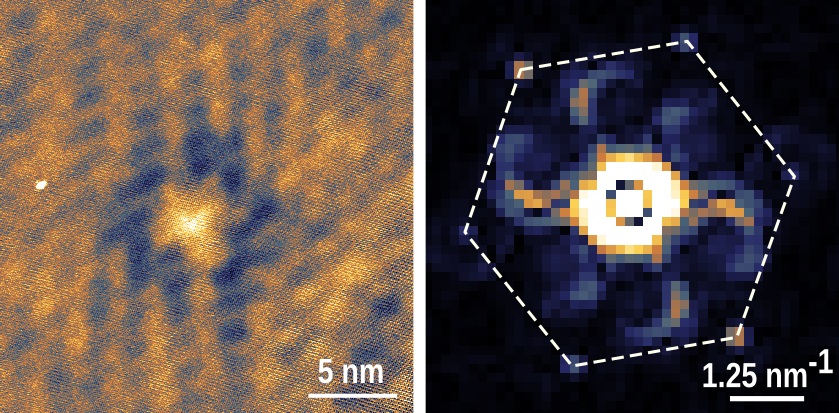
Figure: Interferogram (left) of the twisted bilayers of graphene around an atomic-size defect, measured experimentally by scanning tunneling microscopy.It analysis (right) shows a helix shape that allows to conclude on the topology of the system.
Fundings
- ANR Flatmoi (ANR-21-CE30-0029)
- TGCC-GENCI (Project AD010910784)
- ANR TopoMat (ANR-23-CE30-0029).
Collaborations- University of Washington, Seattle, WA, USA.
- Univ. Grenoble Alpes, CNRS, Grenoble INP, Institut Néel, Grenoble, France.
- Laboratoire de Physique Théorique et Modélisation (UMR 8089), CY Cergy Paris Université, CNRS, Cergy-Pontoise, France.
- Université de Bordeaux, CNRS, LOMA, UMR 5798, Talence, France.